Cleaning Threewells
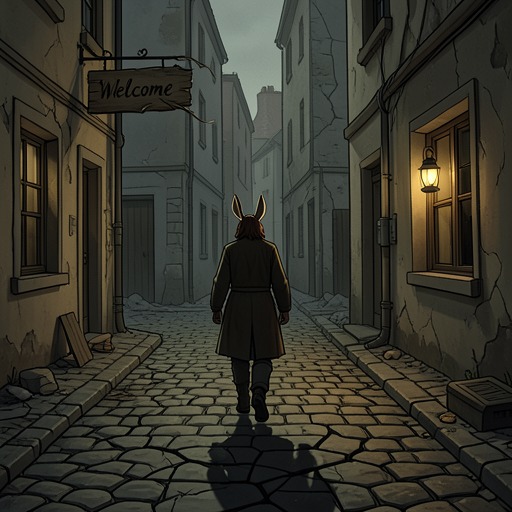
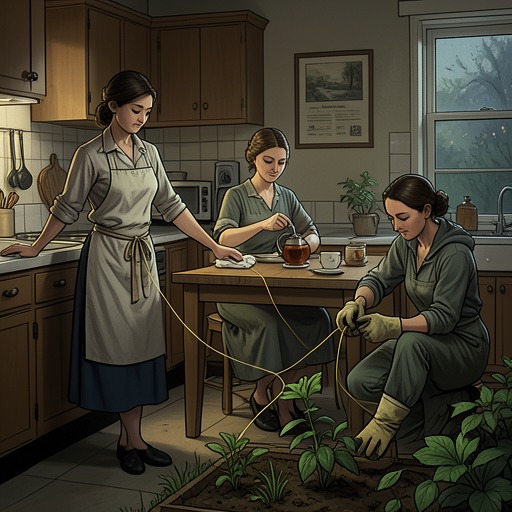
Cinnamon BunCleaning Threewells is not a single chore but a repeated campaign through which Broccoli Bunch makes an abandoned settlement habitable, maps its dangers, and turns cleanliness into a practical form of courage. What begins with wiping a seat and clearing debris develops into the central routine of his stay in Threewells: cleaning improves his measurable abilities, provides a weapon against ghosts, shapes his decisions about friendship and violence, and gives him a concrete purpose while the town’s larger mysteries remain unresolved.
Beginning with Shelter
Broccoli’s cleaning begins from an immediate physical need. The room offers no easy rest, and its only exit is blocked by fallen stones that appear almost as heavy as he is. Rather than accepting the ruined space as it stands, he pulls over the one seat capable of holding his weight and wipes its surface clean. The action is small, but the system recognizes it as a Special Action aligned with his Cinnamon Bun class and announces that he has unlocked the Cleaning skill.
The new skill initially seems almost comically modest. Broccoli regards it as silly and boring, yet also as something that might help if he continued to grind it. His response establishes the characteristic logic of the activity: cleaning is soothing in itself, but it is also an investment whose value can be measured through progress. He takes up a broom and shovel, clears the ground beneath an opening in the wall, and pushes out dead leaves, converting a dangerous obstruction into the first stage of a usable shelter.
Once the room is cleaned as thoroughly as its condition permits, the transformation becomes visible. Mould is brushed from the walls, floors are swept, broken furniture is sorted, and a small table and chair are arranged to one side. Broccoli can finally sit down without the old wood collapsing beneath him. The newly ordered room gives him a place from which to examine his classes and abilities, linking domestic restoration directly to the game-like system that governs his development. His Cinnamon Bun class describes him as a support and friend, and Cleaning becomes an especially literal expression of that identity.
Grinding the Skill
After meeting Bonesy, Broccoli deliberately returns to cleaning rather than treating it as a task already completed. He sorts papers into the least-worn chest in the barracks, hoping they will remain dry long enough for someone to read them, and uses a broom and mop as makeshift dusters. The work fills the room with age-old clouds of dust and leaves him sneezing repeatedly, but the discomfort is followed by a floating system message and a measurable advance.
Cleaning reaches Rank F at 100 percent, allowing the free promotion to Rank E. Broccoli’s progress is therefore not abstract: repeated physical actions alter the status of a named skill, while the system converts persistence into a new rank. He also receives a class point and learns that such points can upgrade a class skill, although he initially refuses to spend the point on Cleaning. The hesitation reveals a tension within the activity. Cleaning is valuable enough to practice constantly, but Broccoli still weighs it against other possible forms of advancement.
The work continues across Threewells. He cleans the inn from top to bottom while deliberately avoiding the room containing the friendly ghost’s body, because entering that space might violate the ghost’s comfort zone and damage their relationship. This boundary is crucial: Broccoli does not treat every supernatural presence as contamination to be erased. His cleaning is selective, guided by social recognition as well as by the desire to remove disorder.
Repeated labor eventually produces another breakthrough. While nearly finished with the inn’s second floor, Broccoli receives notice that Cleaning is eligible for a rank increase. He accepts, and Cleaning becomes Rank D at 00 percent. The advancement turns an apparently humble domestic practice into a durable part of his adventuring profile, one that can be developed through patience rather than combat alone.
Mapping a Haunted Town
Cleaning also becomes a method for exploring and understanding Threewells. Broccoli decides that if he is going to clean the entire town and eliminate its evil ghosts, he needs a record of his progress. Charcoal from the fireplace and a piece of cloth serve as a rudimentary pen and paper. His map is crude, but it gives his labor direction: each cleaned building becomes part of a larger plan rather than an isolated act.
The map allows him to connect ordinary exploration with the town’s supernatural geography. He cleans houses, investigates their contents, and returns to the map in the fading light to scrub out mistakes and update it. In one such routine he enters a house far from the church, performs his usual combination of snooping and cleaning, and works for nearly an hour until sunset. The activity raises Cleaning while Insight also develops, showing that the physical ordering of spaces accompanies an expanding capacity to read them.
The campaign takes place under pressure from larger threats. Threewells contains an evil ghost, a foreboding hole in the ground, and a root associated with a deeper evil. Broccoli knows that he must continue exploring, but cleaning gives that exploration a repeatable structure. He can make progress even when he is not ready to confront the most dangerous supernatural presence directly. The town is therefore approached through a rhythm of sheltering, searching, recording, and restoring.
Cleaning as Magic and Combat
Cleaning eventually crosses the boundary between maintenance and force. During an attack, a ghost grabs Broccoli’s face, its claws digging into the back of his head and cheek. Broccoli responds with an apology before Cleaning magic shoots into the ghost and causes it to burst apart. The same ability that began by wiping a seat and clearing dead leaves can now destroy an undead attacker.
This use of Cleaning changes the meaning of purity in the setting. The skill does not merely make surfaces pleasant or remove dust; it identifies a hostile ghost as something that can be expelled through magical cleansing. Yet the earlier avoidance of the friendly ghost’s room complicates any simple equation between cleaning and extermination. The ability can be a weapon against danger without requiring Broccoli to regard every ghost as an enemy, and his social distinctions determine where cleansing is appropriate.
The skill’s later status reinforces its practical importance. When a marsh slime catches Broccoli with a long limb around his waist, Mister Menu displays Cleaning at Rank C and 100 percent. The recurring appearance of the skill during danger shows that its progression is not confined to peaceful work. Cleaning has become an active survival tool, capable of intervening when Broccoli is physically restrained and threatened by a magical creature.
Order, Friendship, and Purpose
Broccoli’s Threewells campaign joins personal comfort to a broader ethic. He cleans because he needs shelter, because he enjoys the soothing repetition, because the system rewards practice, and because the town’s ruins can be made safer. He also cleans while trying to decide what kind of adventurer he will be. After reflecting on the danger around him, he reaffirms a preference for making friends before raising a fist against people he does not understand; Cleaning belongs to this same pattern of constructive action.
The activity repeatedly encounters forms of matter that resist easy classification. Broccoli uses cleaning magic on a ghost, examines the Dungeon Core for the Wonderland Dungeon and an Evil Root, watches pixies gorge themselves on honey until their wings become too sticky to fly, and confronts the unpleasant discovery of dead bugs in a stew. He is capable of discomfort and disgust, but the narrative does not allow cleanliness to become a simple rejection of everything unfamiliar. Even the slime is explained as a concentration of ambient mana that clings to magical things rather than as a moral evil.
Cleaning Threewells therefore remains both literal and symbolic. It restores rooms, clears paths, and improves a ranked skill, but it also gives Broccoli a way to answer abandonment without surrendering to it. His crude map, repeated routines, guarded friendships, and increasingly potent magic all grow from the same decision: to make a damaged place more orderly while learning which forms of disorder must be removed, which must be understood, and which must be left alone.